


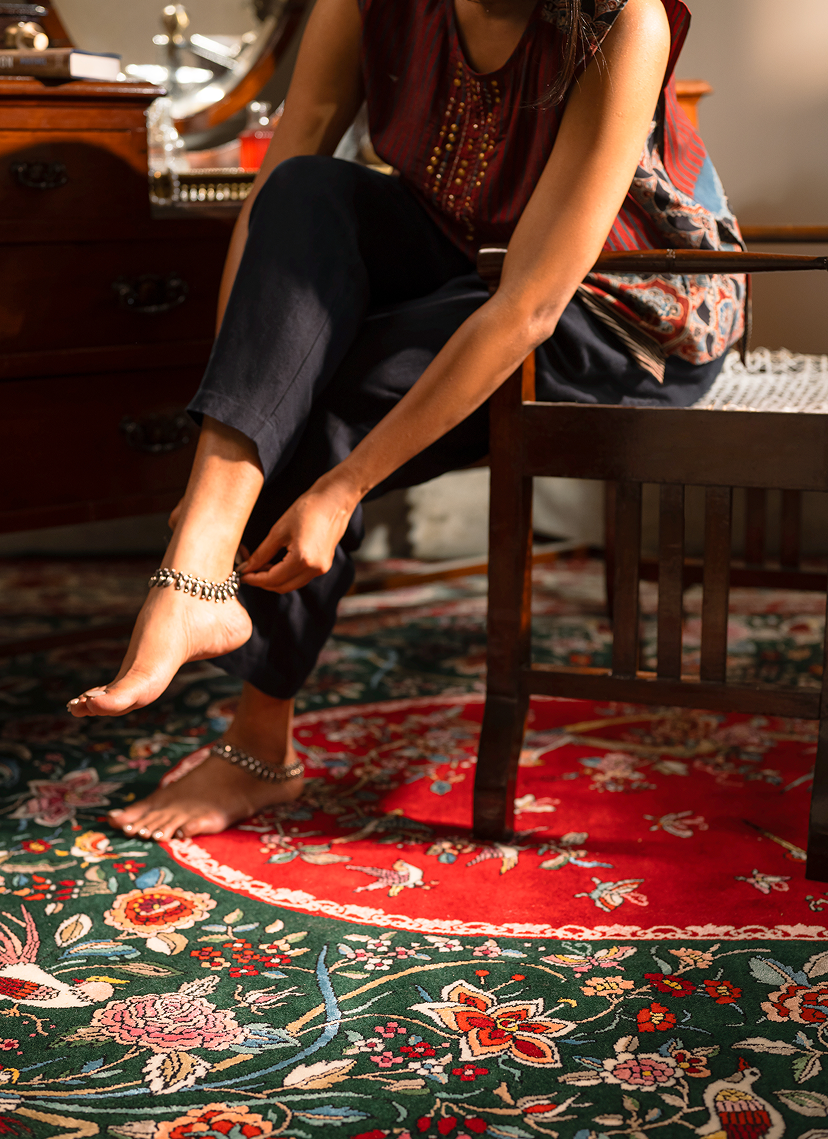
A palette drawn from the natural world
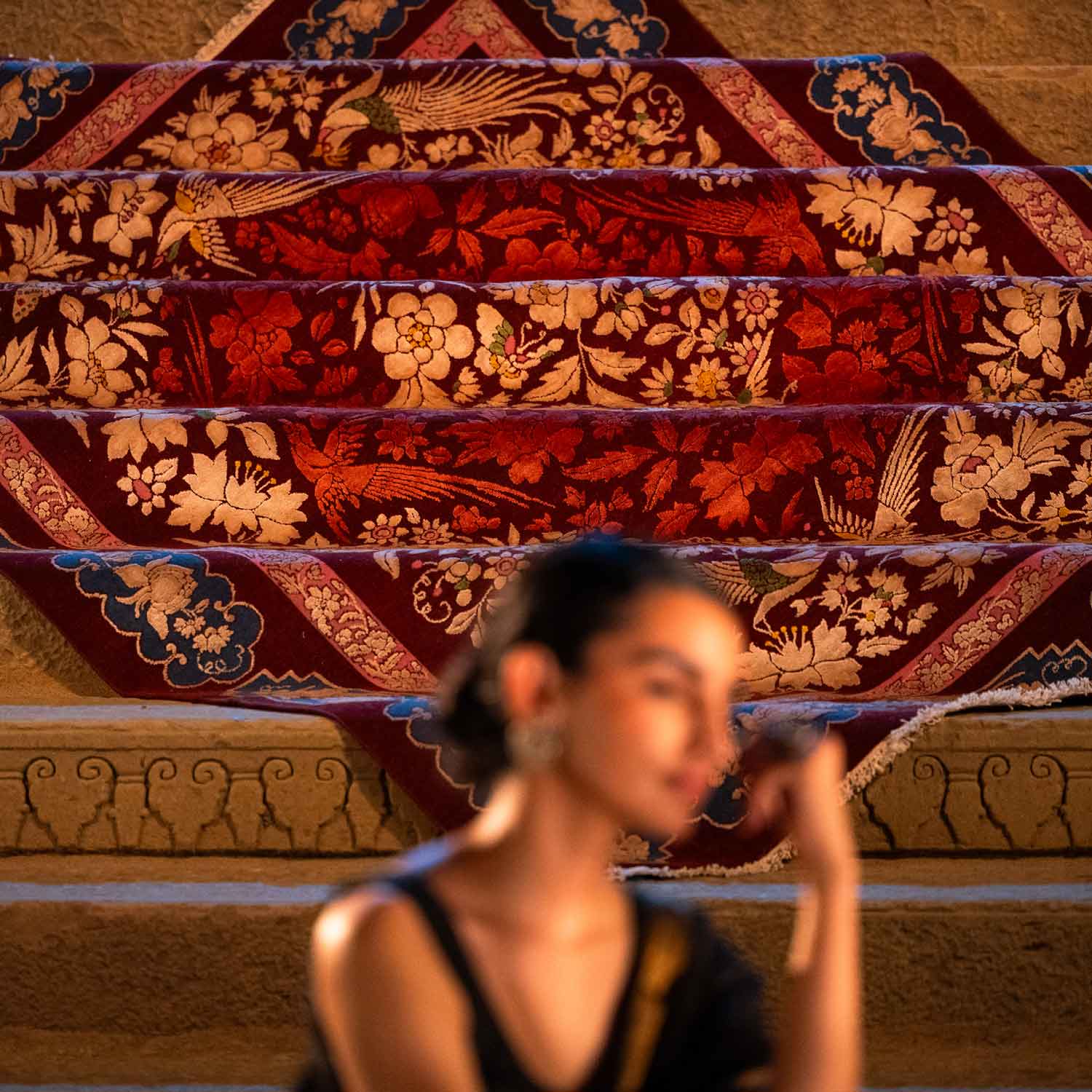
The deep, enduring reds for which Persian carpets are renowned were drawn from the root of the madder plant, dug after several years of growth and prepared with great care. The blues, ranging from the palest sky to the deepest navy, came from indigo, fermented and worked in a process requiring real mastery. Yellows and golds were won from saffron, from pomegranate rind, and from the petals of certain flowers; browns from walnut husks; the quieter greens from the careful layering of yellow over blue. Each colour represented not merely a hue but a body of knowledge — which plant, gathered in which season, prepared by which method, fixed by which means.
Because these dyes were prepared in modest natural batches, no two were ever perfectly identical, and the yarn carried this gentle variation into the loom. This is the source of the living quality of naturally dyed colour: it is never flat, never mechanical. And crucially, it does not fade as synthetic colour fades.
Under years of light it softens and deepens, growing richer with age rather than poorer — a carpet maturing toward beauty rather than declining from it.
Abrash: the mark of an honest hand
Across the field of a naturally dyed carpet, the colour will often shift by subtle degrees — a band where a blue deepens, a passage where a red turns warmer. This phenomenon, known as abrash, arises when one natural dye lot gives way to the next, and it is among the surest signs that a carpet was coloured and woven by traditional means. To the uninstructed eye it may appear an irregularity. To the knowledgeable, it is the opposite: the visible signature of an authentic process, and a quality that hand-finished carpets are valued for, not faulted for. A field of perfectly uniform colour is the mark of the machine. The living, breathing field is the mark of the hand.

Knowledge that the carpet cannot show on its own
Here lies a difficulty that the carpet itself cannot resolve. Once the colour is set and the carpet laid down, no eye can tell from the surface alone whether an indigo was drawn from the plant or matched in a vat, whether the dye lots were natural or formulated to imitate them.
The truth of a carpet's colour lives upstream of the finished object — with those who sourced the materials, prepared the dyes, and watched the colour enter the wool.
Where that closeness to the making is lost, the knowledge is lost with it, and the carpet is left beautiful but mute about its own nature. It is this closeness that Obeetee has maintained for over a hundred years — a continuity with the dye and the wool and the loom that allows the company to speak with certainty, not conjecture, about how a carpet was coloured and how it will age across the decades. To choose a carpet from those who hold such knowledge is to choose colour that will endure and improve, rather than colour that will tire.
Colour that has a past, and a future
The reward of the old methods reveals itself slowly and surely. A carpet coloured from the earth will sit in a room and quietly grow more beautiful. The sunlight that would bleach a printed pattern instead ripens a natural one. Years on, the red still carries its depth, still shifts gently in the changing light, still refuses to be a single flat tone. To bring such a carpet into a home is to bring in colour that was once alive in the natural world — and that, in its own way, remains so.
