




The carpet as a garden
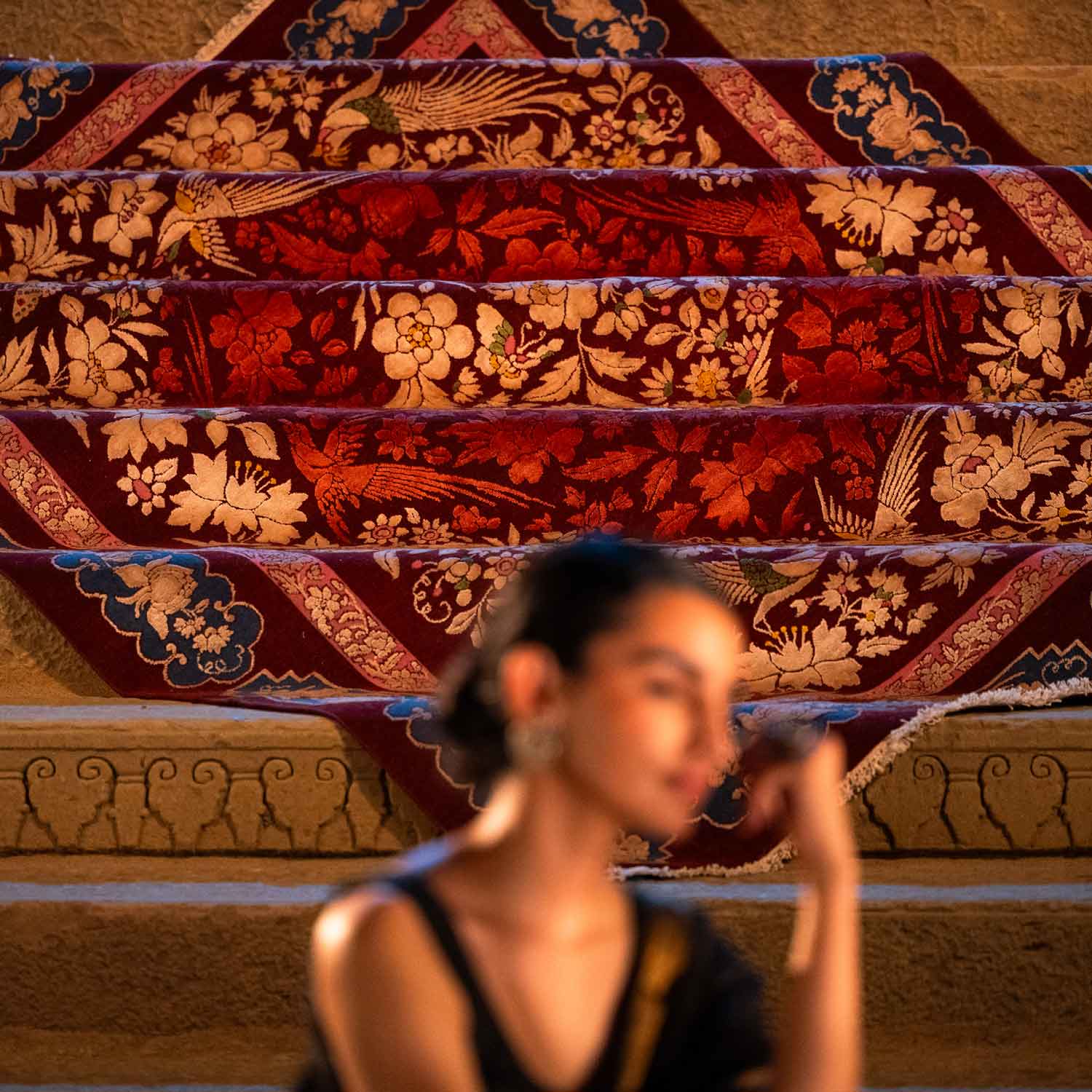
Many of the oldest and most revered Persian designs are gardens — not in a loose poetic sense, but as deliberate renderings of the formal paradise gardens seen from above, with its water channels, flowering beds, and ordered rows of trees, all distilled into pattern over generations. The blossoming vines, the vases, the flowering fields of the classical carpet descend from a profound and ancient idea: that a carpet might bring the garden of paradise indoors, into a season and a climate that could not sustain one, and hold it permanently in bloom.
Understood thus, a formal floral carpet becomes something far greater than an ornament for the floor. It is a garden one may walk upon in the depth of winter, an image of paradise kept eternally flowering. The recurring teardrop form, the heraldic ancestor of the motif the West would later call paisley — belongs to the same enduring vocabulary.
These motifs travelled across empires and centuries, and they survived because they carried meaning to those who wove them.
Composition as instruction
The very layout of a carpet conveys its intention to those who understand it. A carpet built upon a single commanding central medallion behaves as a painting does: it possesses a clear focal point, it asks to be the centre of attention, and it draws the arrangement of a room around itself. A carpet woven with an all-over repeating field has no single centre; it is calmer and more accommodating, content to lie beneath an entire room without demanding the eye. The geometric, grid-based designs of the village and tribal traditions accomplish something different again, imposing a clear and architectural order upon the floor.
This is why two carpets of equal size may govern a room so differently. One organises the space around itself; the other quietly supports it. To recognise the distinction is to choose a carpet with real understanding — to match the temperament of a design to the room it is intended to complete.

Motifs that point to their makers
Certain patterns are bound so firmly to certain places that they serve almost as a signature of origin. The diamond medallion encircled by small fish-like forms — the Herati design — recurs across whole regions and periods. Particular border patterns, particular conventions for drawing a vine, a blossom, or a leaf, belong to one weaving tradition and not another. To the learned eye, the pattern is therefore not only a thing of beauty but a form of evidence, pointing back toward the school and the lineage that produced it.
It is this layer of meaning that is most readily lost in the ordinary passage of a carpet from hand to hand.
A pattern is admired, sold, and laid down, and the significance woven into it — the place it indicates, the idea from which it descends — quietly disappears.
To preserve that meaning requires those who have remained close to these designs across generations and who regard the story of a pattern as inseparable from the carpet itself. Obeetee has treated this knowledge as part of what a carpet is, and not as an ornament to it: the design, and the meaning the design has carried for centuries.
A pattern that rewards a lifetime
The reward of the old methods reveals itself slowly and surely. A carpet coloured from the earth will sit in a room and quietly grow more beautiful. The sunlight that would bleach a printed pattern instead ripens a natural one. Years on, the red still carries its depth, still shifts gently in the changing light, still refuses to be a single flat tone. To bring such a carpet into a home is to bring in colour that was once alive in the natural world — and that, in its own way, remains so.
