From Sacred Sound to Sacred Space: The Mantra Collection
In Eastern cultures, a mantra represents a sacred sound, a word or phrase repeated to help calm a restless mind, turning repetition into a form of meditation. Mantra by Angeli Sowani x Obeetee starts with this concept, transforming the rhythm of sacred sound into a tactile expression through weaving, where repeating lines, evolving forms, and geometric patterns seamlessly flow across the surface, reminiscent of a phrase returning in meditation.
This collection blossomed during a transformative time in Angeli Sowani’s life. After nearly four decades spent in the sunlit expanses of Asia, her move to England introduced her to a radically different environment, marked by rainy skies, shifting seasons, and an entirely new light compared to what she had been accustomed to. Interestingly, distance can bring some memories closer. Landscapes that once filled her everyday life reemerged in fragments—the deep, resonant chants of Himalayan monasteries, the sunlight pouring over the Kathmandu Valley, and the moonlit waters of the Indian Ocean - while the colors and moods of England gradually blended into her visual memory.

This combination of locations sparked the inspiration for Mantra. The collection doesn’t strive to literally recreate these landscapes; instead, it reflects on what remains of a place once you’ve moved on, when geography begins to blend into colors, textures, and feelings. England and Asia intertwine within the work, sometimes contrasting sharply and at other times melding so seamlessly that it becomes hard to discern where one memory ends and another starts.
In Inner Weaves, this notion takes shape as a delicate line that travels across the canvas, disappearing only to reemerge. Drawing from the art of hand-knotting, the design encapsulates the rhythmic essence of weaving, where countless individual movements coalesce into a greater whole. The line also conveys a more personal sentiment: connections between people, places, and moments may not always be visible, yet they persist, appearing, vanishing, and recapturing our attention in ways we might not immediately recognize.
The evolving landscape of England is vividly portrayed in Winchester Cool and Winchester Warm, two rugs that initiate from the same locale but recall it differently. Winchester Cool takes inspiration from the tempestuous clouds and rain-drenched skies of the West, with its muted palette evoking the gentleness of drizzle and the introspective nature of an English winter. Yet within this cool setting lies the memory of a much warmer place: sunlight filtering down from the Himalayas onto the Kathmandu Valley. The two landscapes converge on the same surface, unified not by geography but by memory.
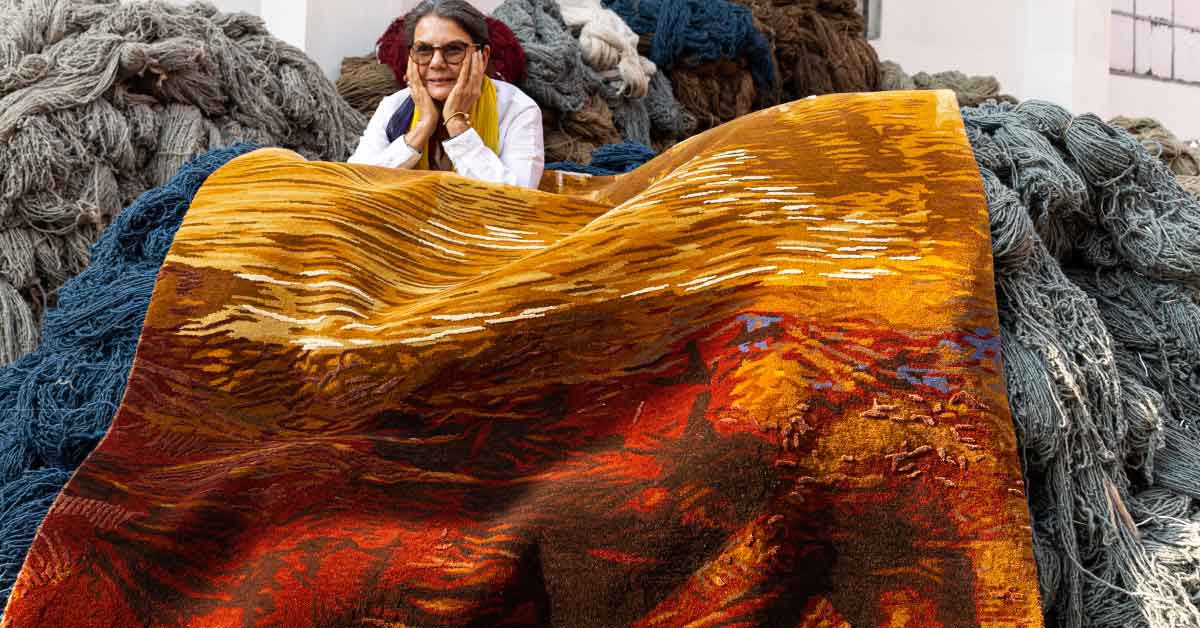
Winchester Warm, partially inspired by Angeli’s visit to Winchester Cathedral, embraces golden hues and mustard tones, capturing the warmth of an English autumn while echoing elements from the East. There’s something special about seeing familiar colors in an unfamiliar setting; it can make the distance between one’s current location and past memories feel much smaller. In this rug, this recognition evolves into a meditation on new beginnings and the surprising ways a fresh landscape can bring old notions of home back into focus.
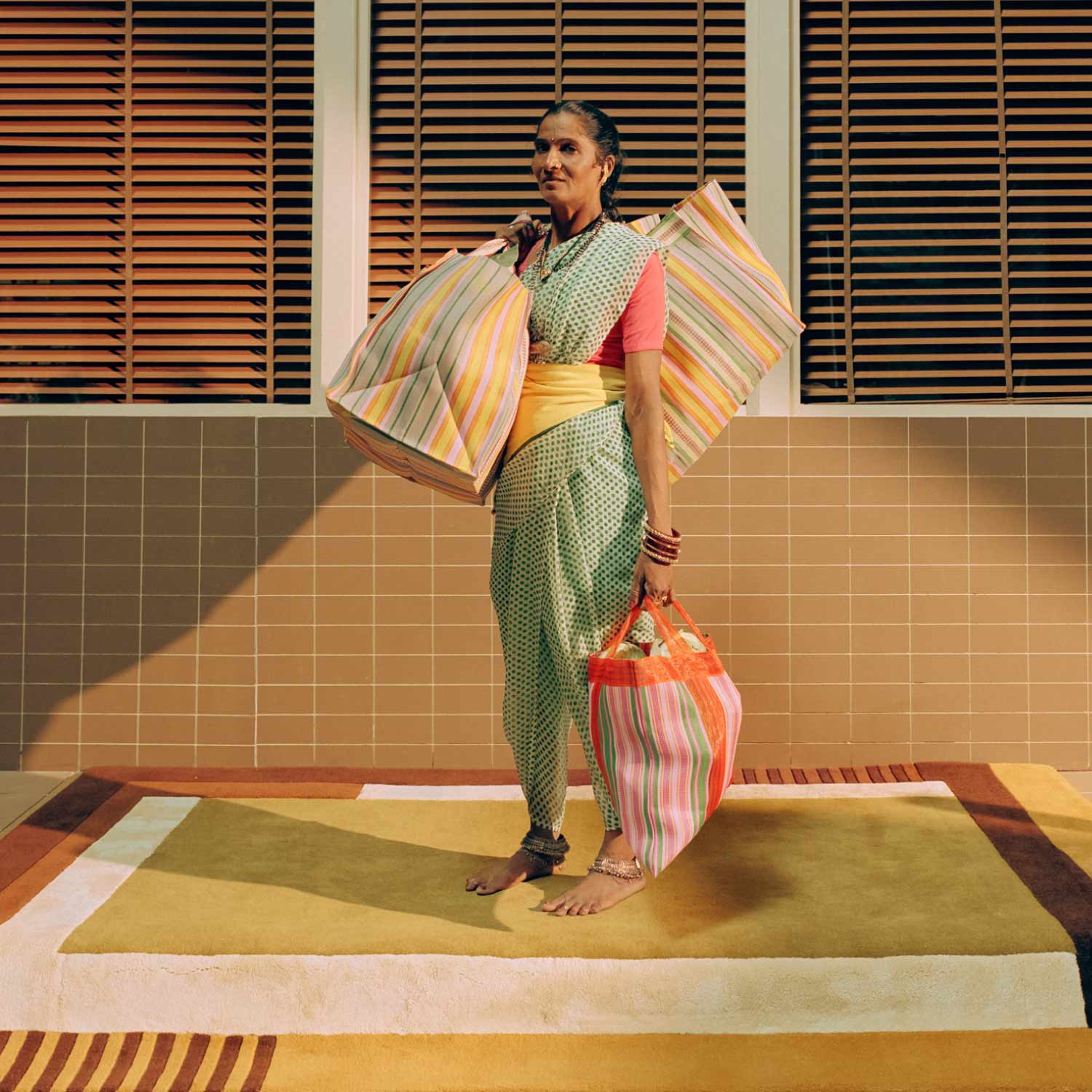
With Luna, the scope extends even further as moonlit shores of the Indian Ocean intertwine with sunlit Tibetan monasteries. Crafted in browns, lunar tones, and hints of gold, the rug unites two distinct experiences of light, while abstract, box-like shapes emerge across its surface, reminiscent of architectural fragments or places recalled only in fleeting moments. Nothing is depicted exactly as it was; rather, the landscape has passed through memory, becoming softer, more abstract, and perhaps more personal along the way.
Repetition is crucial to this visual language. Much like Tibetan prayer flags carrying blessings into the wind, the recurring geometric elements throughout the collection imply that an idea can gather depth through its repetition. A motif may reappear, but never in quite the same manner; a color may evoke one landscape only to unexpectedly connect to another. Thus, Mantra is both inspired by the concept of sacred repetition and constructed from it.
Movement is more pronounced in Alara, where vibrant blues, fiery shades, and white accents flow across the canvas with the dynamism of sea foam lifting into the air. This rug also draws inspiration from the late Indian dancer Astad Deboo, whose unique movement style blended various traditions without being confined to any single one. That same fluidity permeates Alara, where the rhythm of weaving becomes almost gestural, lending life to the surface even in moments of stillness.
The collection’s journey through change finds its most tangible expression in Maya, a hand-knotted rug crafted with a dual-sided design that allows its top layer to be flipped over, revealing alternate colors and motifs. Inspired by the warm waters and sun-drenched earth of the East, the rug invites interaction rather than mere observation, altering its character based on how it’s positioned. Its name, Maya, embodies the concept of illusion and the ever-shifting nature of perception, aptly reflecting a piece that deliberately resists remaining static in one particular form.
Throughout the six rugs, spaces that may otherwise appear distant are brought together. The grey skies of England coalesce with the light of the Himalayas, the Indian Ocean merges with Tibet, and the movement of a dancer is woven into the loom's structure. These are not precise portrayals of Angeli’s travels but rather the impressions they’ve left behind, gathered over years and brought back into view after a significant shift in setting and perspective.
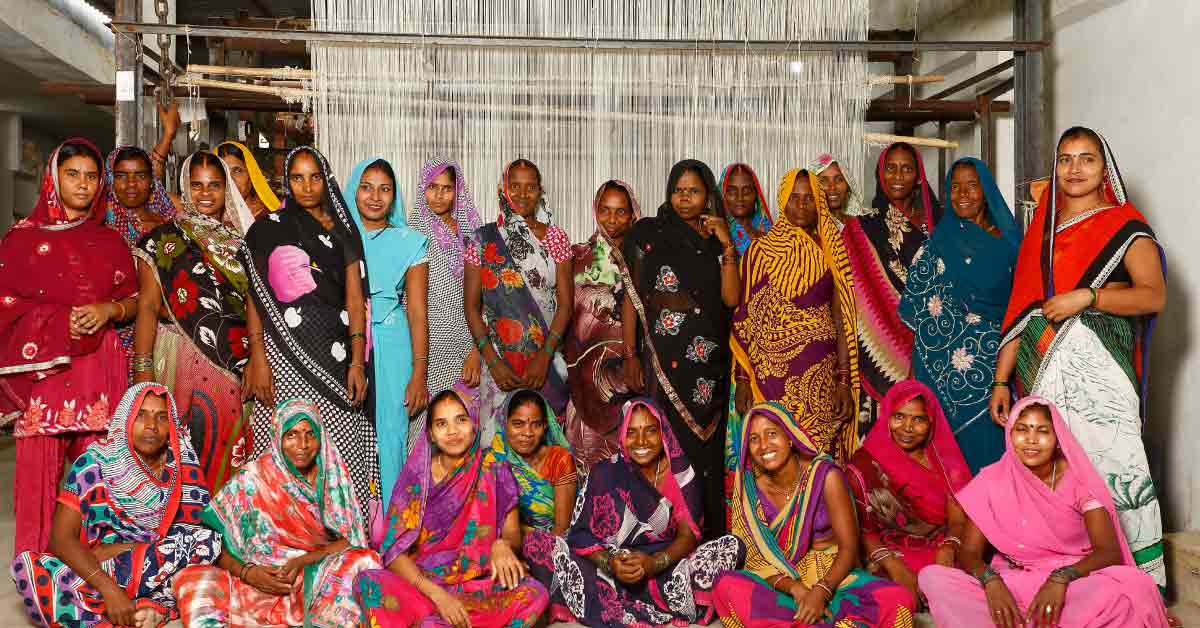
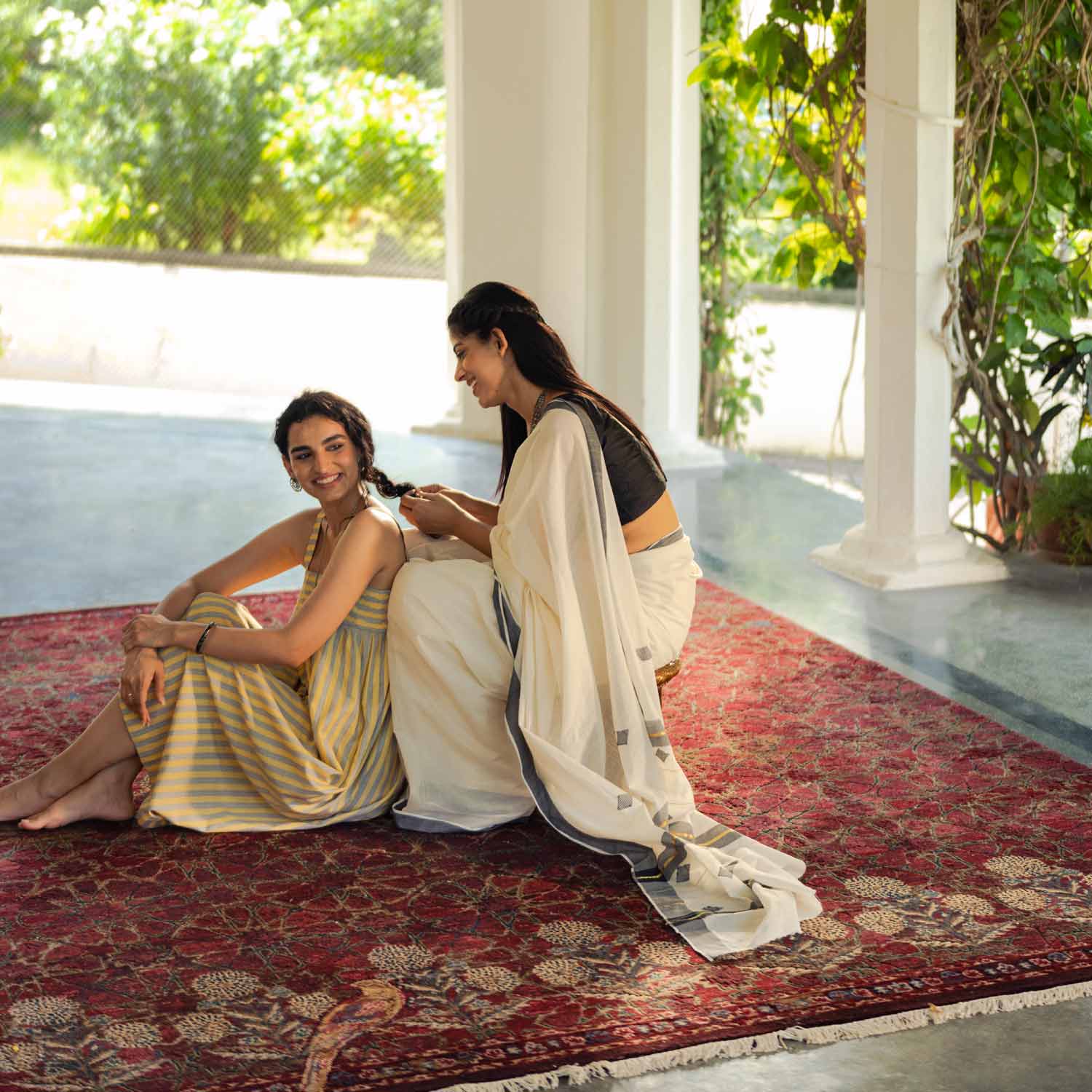
Handcrafted by Obeetee’s skilled artisans using fine wool, silk, and viscose, the collection also mirrors the theme of repetition inherent in its creation. Each hand-knotted rug is constructed gradually, with each knot following the previous one, where every single action becomes almost invisible in the finished product. This is a process that demands patience, care, and a return to foundational practices, much like the practice from which the collection derives its name.
In Mantra, sacred sound doesn’t vanish when it transforms into space; it simply adapts into another manifestation. Repetition evolves into design, memories materialize, and the places we've experienced continue to resonate with us, woven into the spaces we now call home.